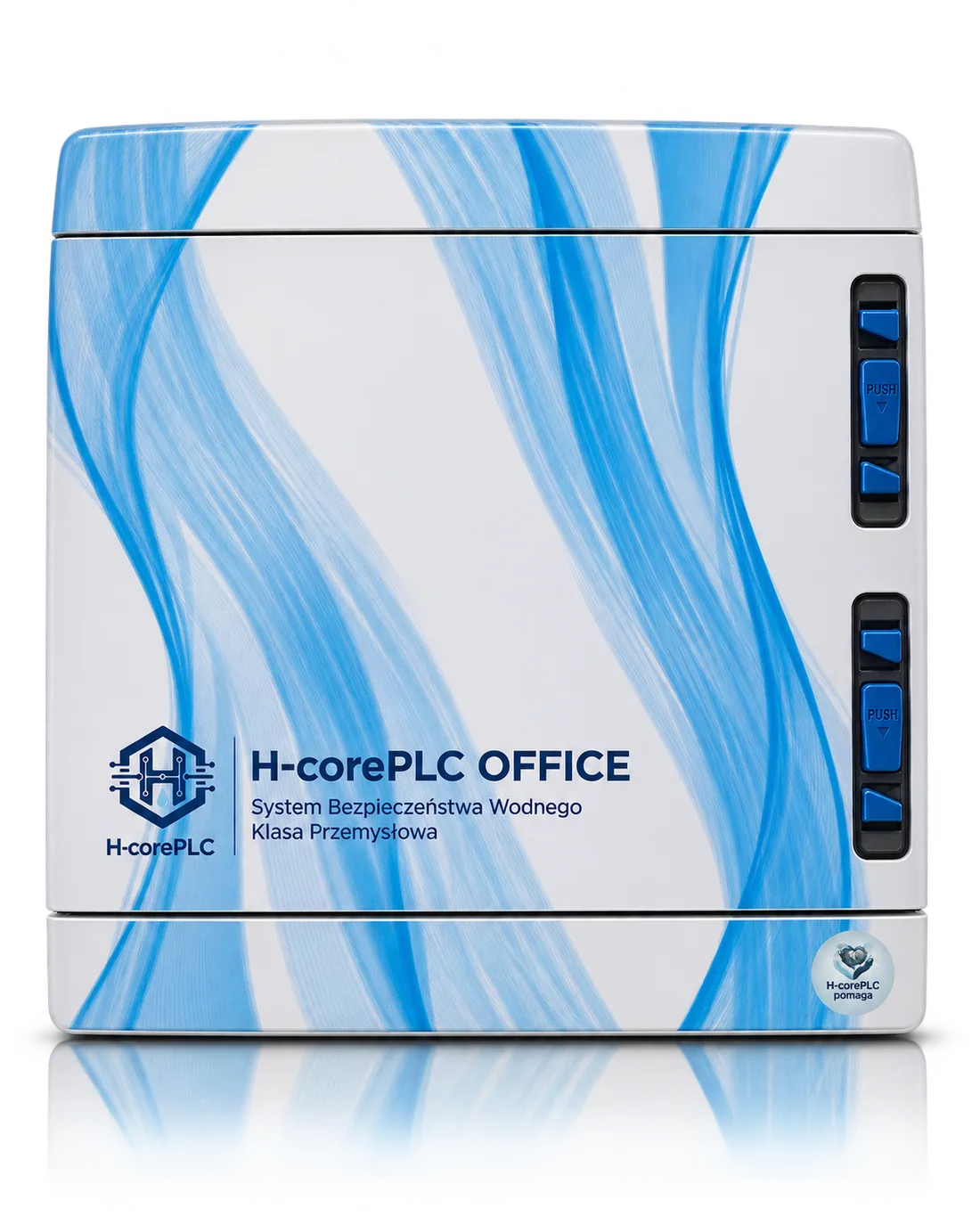
The market for flood protection systems falls into four main technology groups. Each of them has critical limitations that Industrial-to-Home class systems (based on PLCs and high-pressure fittings) eliminate.
01The Scandinavian school of precision (Sweden / Norway)
Historically the oldest and most stringent market — with Safe Water insurer requirements.
Systems such as M4 or Pro use flow sensors and overnight static pressure-drop tests.
Focuses on mechanical durability and simple pressure switches.
02German premium fittings (Germany / Switzerland)
Systems integrated with a domestic water treatment station.
They use pulse counters and electronic time and volume limit settings.
03American digital analytics (USA)
Systems based on “listening” to the pipes.
They analyse ultrasonic waves and pressure 240 times per second.
04European building automation (Poland / Italy / France)
Simple resistive modules mounted in distribution boards.
The F&F ASP system is a wired leak protection system based on moisture probes. When any probe detects water, the control unit closes the solenoid valve and shuts off the water supply to the installation. The solution relies on detecting the presence of water in the protected rooms, not on analysing flow parameters in the installation.
05The UK market
The most important and most widely recognised systems on the UK market:
Waterguard Services Ltd is regarded as the British standard in leak detection. Its systems are modular and often required by insurers in apartment blocks. Waterguard Solo — a simple, insurer-approved “fit and forget” system for flats. Waterguard Series 7 — an advanced system monitoring main water meters (often used for BREEAM WAT 02/03 compliance), using precise pulse meters (1 or 10 litres per pulse) and time logic. Unlike “smart” systems, Waterguard focuses on wired reliability and WRAS (Water Regulations Advisory Scheme) certification.
A direct competitor of Waterguard, specialising in protecting large office buildings and luxury residences. Aqualeak WG — a system for commercial buildings that monitors water volume over defined time intervals. Distance detection — advanced systems (e.g. LD5200) that pinpoint the leak location on a sensing cable to within ±1 metre over a length of up to 3000 metres.
Gaining popularity in England as a modern alternative to impeller meters. Ultrasonic measurement detects micro-leaks without moving parts that could seize up due to limescale (a common problem in the south of England). Compact and often recommended by British plumbers as a “retrofit” solution for existing installations.
Global brands, positioned in England as the top tier of “connected” systems. Flo by Moen is valued for its MicroLeak™ feature — nightly pressure tests of the installation. Phyn Plus is considered the most “intelligent” at recognising the “signature” of individual appliances (e.g. it can tell a toilet flush from a burst pipe).
06Comparative analysis: H-corePLC® vs European standards
| Feature | German / Dutch (Smart & Connect) | Swedish / Swiss (mechanical precision) | Polish (mass-market / IoT) | H-corePLC® |
|---|---|---|---|---|
| Control philosophy | Cloud and app (IoT) | Hydraulics and mechanics | Spot sensors (wireless) | PLC logic (hard-wired) |
| Micro-leak detection | Medium (~1.0 l/h) | High (~1.0–1.2 l/h) | No flow detection | Extreme — 3rd generation (0.05 l/h) |
| Operating algorithm | Time schedules | Pressure / flow measurement | Alarm once the floor is flooded | [V, Q, T] analysis + reset, hose threshold |
| Communication | Wi-Fi / Modbus / KNX | Wired / local | Z-Wave / Wi-Fi / radio | Binary (direct) |
| IT reliability | Dependent on servers | High autonomy | Risk of radio interference and battery failure | Island network (autonomous) |
| Integration (alarm / BMS) | Complex gateways | Relay outputs | Often missing or “forced” | Dedicated interface — 4 signals; 3rd generation: 11 signals |
| Protection [hose] | Reaction after a time delay | Robust shut-off | No flow-based protection | Instant action |
| External equipment support | Rarely (proprietary ecosystems) | No dedicated inputs | No station support | Optional mode, 2nd generation [Regeneration] |