 Book a presentation
Because it combines two independent layers of safety into a single whole, controlled locally by the PLC: active volumetric monitoring on the main pipe (a water meter with a pulse transmitter) and Zamel wireless spot detectors placed in critical zones.
They provide a fast, dedicated spot detection channel in places where a sudden leak can occur (e.g. under a washing machine or dishwasher), sending the signal by radio directly to the PLC controller’s inputs.
A spot detector only reacts once water physically reaches the floor. Flow measurement using the water meter on the main connection works preventively and detects damage (e.g. cracks inside a wall or ceiling) before the water has even spread through the building.
The Zamel radio system receiver is wired directly to the PLC controller’s hard-wired binary inputs, so a detector being triggered causes an immediate, local response (valve closure) without any intermediaries or the cloud.
Zamel detectors work with a local, dedicated hardware receiver and are tied into the controller’s industrial logic, completely eliminating dependence on the home Wi-Fi router, a mobile app and external cloud servers.
It combines two different detection methods: Zamel detectors react immediately to water on the floor in risk zones, while the flow counter in the PLC protects the rest of the installation (including risers and hidden concealed pipework).
The system works deterministically, based on the PLC controller’s fixed cycle, defined thresholds and measurable physical parameters. As a result, its response is repeatable, predictable and independent of internet access and cloud services.
No. All safety functions are performed locally by the PLC controller and the actuators installed in the building. Failure detection, flow analysis and valve closure work independently of internet access, Wi-Fi and cloud services.
The water meter with a pulse transmitter generates pulses proportional to the volume Q that has flowed through. These are fed into the controller’s high-speed counter (HSC) input and form the basis for dynamic calculations.
If the water flow rate exceeds the defined threshold, the PLC controller immediately treats it as a failure (e.g. a burst hose under a tap) and closes the main EZ solenoid valve without delay.
The system counts continuous draw-off up to a limit (e.g. 35 litres). For the counter to reset, the operating cycle must include a complete break in flow lasting at least 15 seconds. Without a break during continuous draw-off, the volume counter reaches its threshold and the water is shut off.
Proven, reliable compact units such as the Siemens LOGO! (version 8/9) or the Eaton easyE4 — depending on the version supplied. A PLC controller is an industrial standard offering stable parameters, predictable operation and hardware high-speed counter (HSC) inputs.
It has a dedicated Pause function. The user switches it on deliberately (e.g. by double-clicking a doorbell-type push-button), which temporarily suspends the volume limit, allowing water to be drawn freely without false alarms.
The built-in Watchdog (Auto-exit) kicks in. After exactly 40 minutes, the PLC controller automatically and unconditionally returns the system to active “Guard Mode”, eliminating human error.
Importantly, the building’s protection is not switched off during the pause — the installed Zamel spot detectors and the Qmax hose threshold remain active.
Yes. The user can return to standard monitoring at any time by holding the control button for 2 seconds.
In addition, the system has a built-in flow watchdog: if the flow stops for at least 3 minutes during the pause, the controller automatically exits the pause and switches to Guard Mode.
Flows below the failure detection threshold are not the primary focus of the system. Responsibility for fixing minor leaks and keeping the water installation in proper technical condition remains with the owner or manager of the property.
Yes — but only in the H-corePLC® office version. This system monitors flow on the main connection and can detect abnormal water draw-off as soon as the installation is damaged, even if the leak is inside a wall, ceiling, service shaft or another inaccessible space in the building.
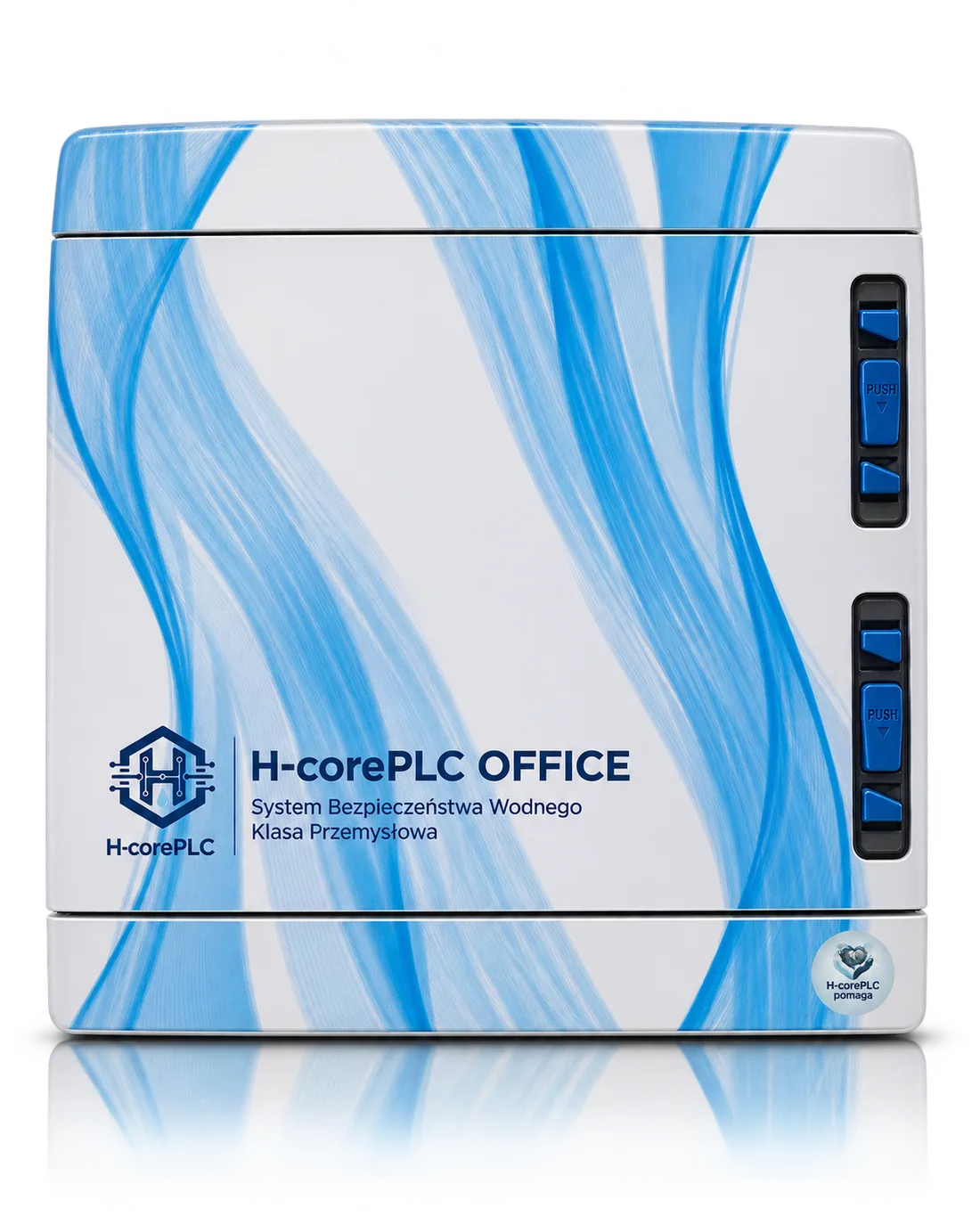
The standard versions of the system do not have a built-in backup power supply — the investor provides a UPS at their own discretion. The exception is the H-corePLC® office version, which comes factory-fitted with an integrated backup power system.
The system core was originally designed in 2010–2013 for the easy 512–819 controllers of the time. In 2026 it was thoroughly rebuilt, modernised and adapted to the new LOGO! 8 platform — with completely different logic and functionality. It is a new system on a new platform that takes only two aspects of the proven core from the original design. Fully adapted to consumer requirements, it offers the highest reliability and effectiveness compared with solutions based solely on detectors.
They undergo a full three-stage quality control with a certificate of conformity with the design. The final test takes place on a validation platform, where a separate PLC dynamically simulates all flows and functions to verify fault-free operation.
Installed on site while construction is still under way (during or before plastering and fit-out of the installations). It is unaffected by the specific operation of construction equipment (e.g. a water hose popping off a plastering machine), does not generate false alarms and responds within 3–5 seconds of a plastering-machine hose failure. It has weekend modes and a “szychta” (work-shift) function that replaces the standard pause, and integrates with the PLC2 module for risers. The PLC2 panel performs pressure tests on the building’s risers in accordance with the Polish PN standard and works with all H-corePLC® szychta installations on the riser. No other system on the market has such extensive logic. While the property is unoccupied, safety is maintained by the away/weekend function, and once the apartment is sold the administrator changes just two parameters for the system to switch to residential mode.
The flagship solution for residences, high-end office buildings and archives. It has the most advanced leak-authorisation logic (details of the architecture remain the company’s trade secret).
No. The system should be treated as part of the building's technical infrastructure, not as a plug-and-play device. Correct operation requires the plumbing and electrical installation to be prepared in line with the manufacturer's guidelines. Installation involves precise plumbing and electrical work carried out according to strictly defined guidelines:
- Installation point: the main water service connection, strictly downstream of the garden tap (so that garden watering does not count towards the volume counter).
- Mandatory fittings: a pipe section for the kit — strainer, non-return valve, water meter with pulse transmitter, solenoid valve.
- Mandatory bypass (service bypass): the entire metering and actuating assembly must have a parallel bypass with a manual valve — to maintain water supply during maintenance, meter recalibration or service work.
- Qualifications: a qualified plumber running an active registered business (JDG), which guarantees installation in accordance with good building practice.
- Dedicated supply circuit: the system's control cabinet (RE) must be supplied from a completely independent circuit with its own overcurrent protection. Supplying any other devices from this circuit, or connecting the kit to shared circuit protection, is strictly prohibited.
- Environmental conditions: a dry room, free from dew point conditions (condensation), relative humidity max. 90%.
- Qualifications: the electrical installation and connection of the control cabinet may only be carried out by an electrician holding a valid SEP qualification certificate for up to 1 kV.
for your water system.